

As someone who writes, reads avidly, and is obsessed with history, there is nothing I love more than a group of writers coming together to hone their craft; especially when those writers produced the books that shaped my life.
The Inklings were one of these groups, and they might be my favourite. While often unheard of by the casual reader, this was a true meeting of great minds. Although two members were considered the pack’s celebrities, the Inklings actually consisted of nineteen men over the years.
These men were Oxford professors or professionals working within the city. At the heart of the group was the iconic pair: J.R.R. Tolkien and C.S. Lewis.
Lewis’s brother, Warnie, described the group as having no rules, officers, agendas, or formal elections. It was simply a collection of like-minded men who escaped to the pub or Lewis’s rooms to talk about their craft, advise one another, and offer support.
The Big Four
It is fair to say that Lewis and Tolkien were the anchors of the group; their friendship is legendary. However, it was a relationship filled with tough love. They were not always complimentary about each other’s work.
If you study the creation of The Lord of the Rings, you quickly realise that Tolkien was not a fast writer; his process was slow and meticulous. He would spend years obsessing over Elvish philology and complex genealogies. He often read these drafts aloud during Inklings meetings, testing the patience of his peers.
One evening, while Tolkien was deep into a particularly long passage, Hugo Dyson, a fellow Inkling known for his wit and total lack of patience for high fantasy, reached his breaking point. After hours of listening to Tolkien’s world-building, Dyson sprawled across a sofa and loudly groaned:
“Oh God, no more Elves!”
The room erupted. Tolkien was reportedly quite stung by the remark, but it became a legendary piece of Inklings lore. It serves as a reminder that even the greatest masterpiece in fantasy history had to survive the equivalent of a 1940s ‘tough crowd.’
Reports that Tolkien hated Narnia may be slightly overstated, but he was certainly a harsh critic. He felt Lewis’s world-building was slapdash because Lewis mixed mythologies with reckless abandon. To a linguist like Tolkien, placing a Greek Faun, a Victorian lamp-post, and Father Christmas in the same forest was total creative chaos!
Lewis and Tolkien once famously lamented the state of contemporary literature. They felt that the stories they actually wanted to read, grand myths and cosmic adventures, weren’t being written. Lewis reportedly said to Tolkien, “If they won’t write the kinds of books we want to read, we shall have to write them ourselves.”
The third influential member was Charles Williams, an editor at Oxford University Press and a writer of metaphysical thrillers. A flamboyant, mystical figure, he joined the group when the OUP moved to Oxford during WWII. Williams brought a sense of urban magic to the circle. While Tolkien’s maps were of imaginary mountains, Williams’s maps explored the spiritual dangers lurking in the streets of London. Lewis remarked that when Williams entered a room, the atmosphere changed from “grey to gold.”
The last of the ‘Big Four’ was Owen Barfield, often called ‘the first and last Inkling.’ Barfield and Lewis met as undergraduates in 1919. A philosopher and solicitor, he engaged Lewis in what they called the ‘Great War’—a years-long intellectual debate over philosophy and language that deeply shaped Lewis’s eventual conversion to Christianity. Lewis later dedicated The Allegory of Love to Barfield, calling him “the wisest and best of my unofficial teachers.”
Other Key Members
Warren ‘Warnie’ Lewis: Lewis’s older brother and a retired Army major. He acted as the group’s unofficial secretary and was a historian of 17th-century France. He provided a grounded, common-sense perspective.
Hugo Dyson: Though he helped Lewis find his faith, he was the man responsible for the “No more Elves!” outburst. A brilliant Shakespeare scholar, he eventually grew weary of the group’s leanings toward fantasy.
Robert ‘Humphrey’ Havard: The personal physician to both Lewis and Tolkien. He was the only scientist in a room of literature dons, affectionately nicknamed ‘the Useless Quack’ by Warnie.
Christopher Tolkien: Tolkien’s son joined the group later. He was instrumental in reading his father’s maps and manuscripts aloud when the elder Tolkien’s voice grew tired.
Other associates included Adam Fox, a professor of poetry; Lord David Cecil, a literary biographer; Nevill Coghill, known for his modern translation of The Canterbury Tales; and Roger Lancelyn Green, who became a famous writer of children’s myths.
A Scenius to Envy
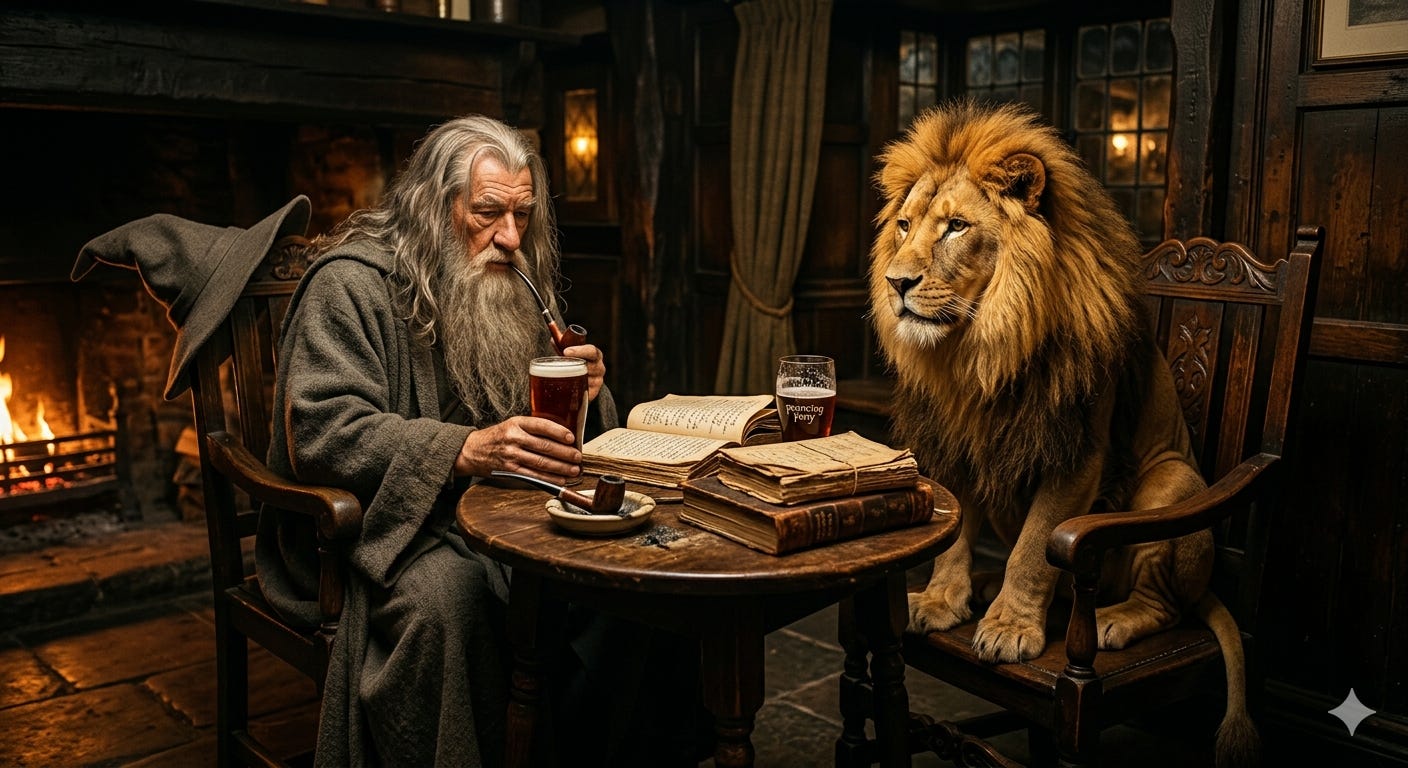
The image of these great minds sitting around a table’ pipes lit, pints of ale in hand, discussing the fate of Middle-earth, is one of the most fascinating snapshots in literary history.
It reminds us that no one creates in isolation. Everyone needs a scenius—a collective intelligence; to bounce ideas off. We all need a ‘beta reader’ who isn’t afraid to be harsh.
Living through the horrors of the World Wars, these men decided the world had become ‘disenchanted.’ The Inklings were a deliberate effort to re-enchant the world through myth. Without this group, The Lord of the Rings might never have been finished. Tolkien was a chronic restarter who would rewrite the first three chapters fifty times rather than move to the fourth. The Inklings, especially Lewis, provided the constant “prod” he needed.
I, for one, am immensely grateful they did. My childhood would have been significantly poorer without the maps of Middle-earth and the wardrobes of Narnia.